A balance sheet is one of the most essential financial statements a business relies on to evaluate its financial position at a specific point in time. Unlike an income statement, which reflects performance over a period, the balance sheet provides a snapshot of what a business owns, owes, and the value left over for its owners. Understanding its key components helps business owners, investors, and lenders assess stability, liquidity, and long-term viability.
1. The Fundamental Balance Sheet Equation
At its core, every balance sheet is built on a simple, universal formula:
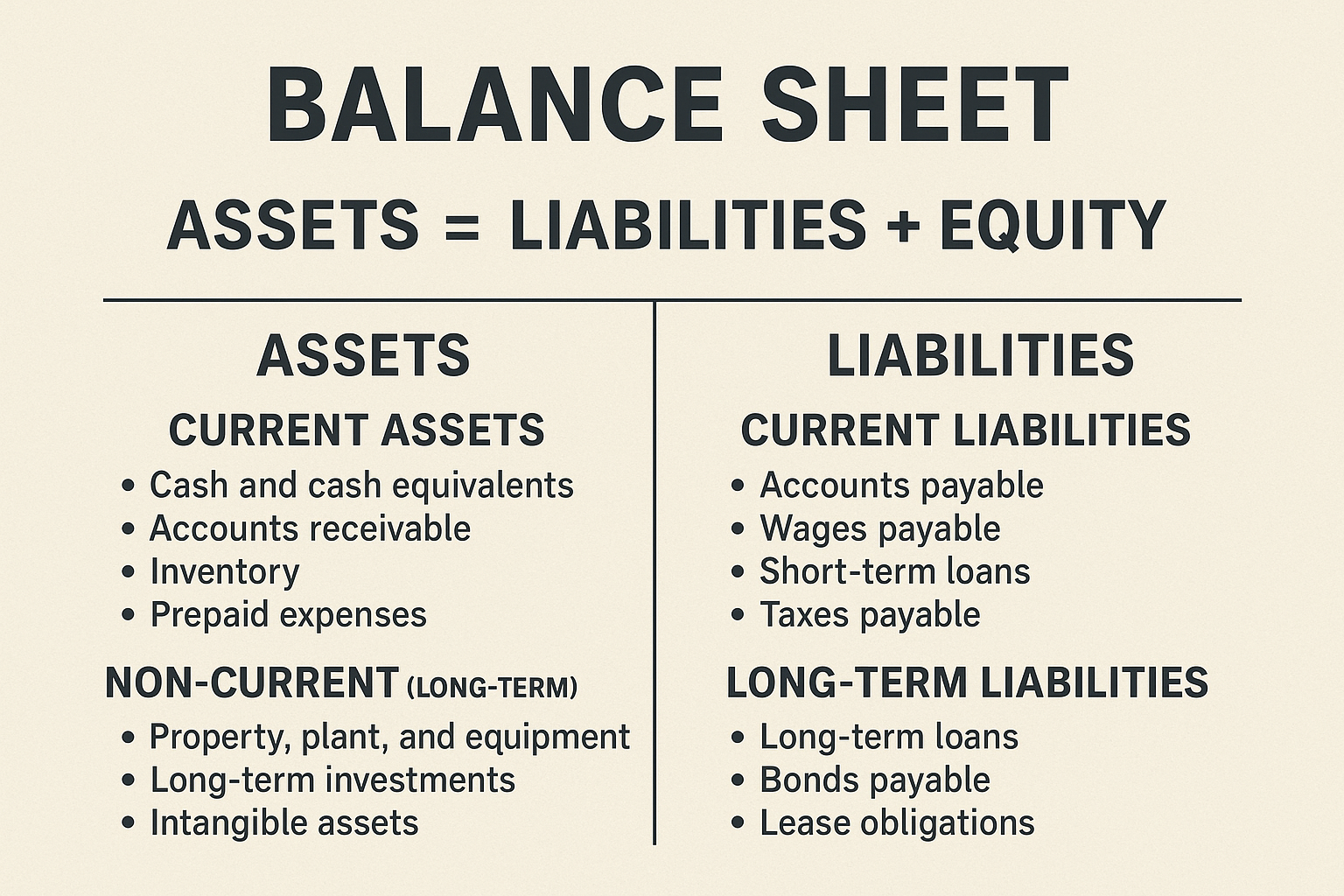
Assets = Liabilities + Equity
This equation must always remain in balance. It reflects that everything a company owns (assets) is funded either by borrowing (liabilities) or by the owners' investment and cumulative earnings (equity).
2. Assets: What the Company Owns
Assets represent the resources that a company uses to operate and generate revenue. They are generally categorized into two groups:
Current Assets
These are assets that can be converted into cash within one year. They reflect short-term financial health and liquidity.
Common current assets include:
-
Cash and cash equivalents
-
Accounts receivable
-
Inventory
-
Prepaid expenses
-
Short-term investments
Non-Current (Long-Term) Assets
These support long-term operations and usually cannot easily be converted to cash.
Examples include:
-
Property, plant, and equipment (PP&E)
-
Long-term investments
-
Intangible assets (patents, trademarks, goodwill)
-
Equipment and vehicles
Understanding total assets provides insight into the scale and resource strength of the business.
3. Liabilities: What the Company Owes
Liabilities reflect obligations that the company must pay in the future. Like assets, they are grouped by when they are due.
Current Liabilities
Obligations due within one year, such as:
-
Accounts payable
-
Wages payable
-
Short-term loans
-
Taxes payable
-
Unearned revenue
High current liabilities compared to current assets can indicate cash-flow pressure.
Long-Term Liabilities
Debt or obligations due after one year, such as:
-
Long-term loans
-
Bonds payable
-
Deferred tax liabilities
-
Lease obligations
Tracking liabilities helps determine how leveraged (or debt-dependent) a business is.
4. Equity: The Owners’ Claim on the Business
Equity represents the residual interest in the company after liabilities are deducted from assets. It's essentially what the business is worth to its owners.
Common equity components include:
-
Owner’s capital or contributed capital
-
Retained earnings (profits reinvested into the business)
-
Treasury stock (repurchased shares)
Positive equity indicates financial stability, while negative equity can signal significant risk.
5. Liquidity and Solvency Indicators
The balance sheet also allows users to analyze financial health through key ratios:
-
Current Ratio (Current Assets ÷ Current Liabilities) – Measures short-term liquidity.
-
Debt-to-Equity Ratio (Total Liabilities ÷ Total Equity) – Measures leverage and long-term risk.
-
Working Capital (Current Assets – Current Liabilities) – Indicates operational flexibility.
These metrics help evaluate whether the business can meet its obligations and sustain operations.
6. Why the Balance Sheet Matters
A balance sheet is more than just a list of numbers—it’s a diagnostic tool that helps stakeholders understand:
-
The company’s ability to pay its bills
-
How efficiently it manages resources
-
Its long-term financial stability
-
Whether it’s highly leveraged or conservatively financed
-
The overall value of the business
Investors use balance sheets to assess risk, lenders use them to evaluate creditworthiness, and owners use them to make strategic decisions.
Conclusion
Understanding the key points of a balance sheet empowers business owners and decision-makers to maintain financial control and plan for growth. By analyzing assets, liabilities, and equity—along with the ratios they produce—you gain valuable insight into both the current standing and the future potential of the business. A well-interpreted balance sheet is one of the most powerful tools for making informed, confident financial decisions. At Charted Legacy Solutions we are trained to interpret and provide valuable insight into all your financial statements. Contact Us to find out how we can help you understand them so that it will be easier to grow your business.